Halcyon Symbios
Halcyon Symbios: all about the chest mount rebreather
Everything about the Halcyon Symbios rebreather: specifications, weight, depth, sensors, HUD and handset, price, and how to learn to dive it.
- Type
- Electronic CCR, chest mount
- Rating
- EN 14143 · 100 m
- Sensors
- 2 galvanic + GreenFlash
- Dive-ready
- 11 kg
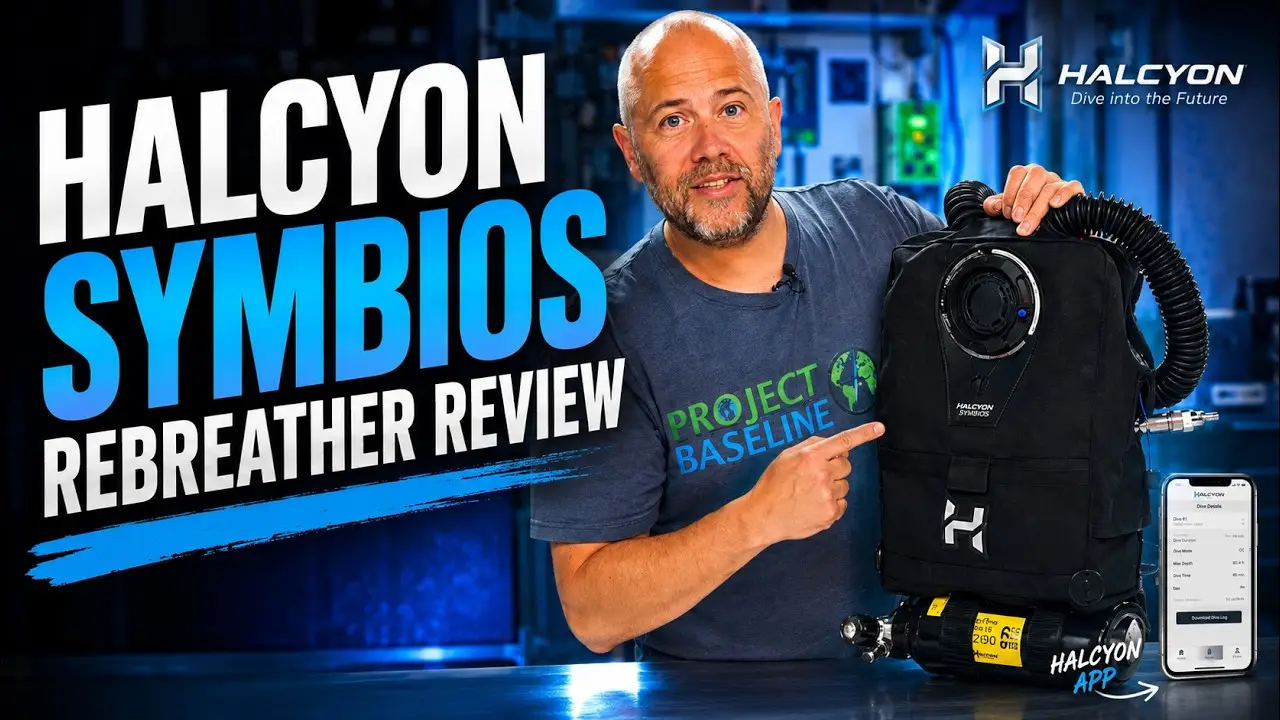
The Halcyon Symbios is an electronic closed-circuit rebreather that you wear on your chest instead of your back. Halcyon showed it at DEMA in November 2024 and has been shipping it worldwide since spring 2026. I have dived it since early 2026, in wrecks, mines and caves down to a hundred metres, and I teach on it. This is the page I wanted to find when I was considering one: what it is, what it does, what it costs, and what you should know before you buy.
What is the Halcyon Symbios?
A rebreather lets you breathe your own exhaled gas again. A scrubber removes the carbon dioxide, a small oxygen cylinder replaces what your body has used, and three sensors check that the oxygen partial pressure is right. On an electronic rebreather like the Symbios a solenoid does the topping up automatically, at a setpoint you choose.
What sets the Symbios apart is where it sits. Almost all rebreathers go on your back, like a twinset. The Symbios hangs in front of your belly, on your harness, with the counterlungs against your body. Your back stays free for a single cylinder, a twinset, sidemount or a camera rig. You can see your own unit, you feel the counterlungs breathe, and you unclip it underwater when you need to reach your drysuit.
The electronics are Halcyon's own, developed with Oxygen Scientific. It is not a Shearwater under another name. The controller sits in the unit; the handset and the HUD are displays that show what the controller is doing, connected wirelessly. How the unit came about, from 3D print to CE certification, developer Arne Sieber tells in my interview in Austria.
Halcyon Symbios specifications
| Item | Value |
|---|---|
| Type | Electronic CCR, chest mounted, automatic solenoid injection |
| Rating and depth | EN 14143:2013, to 100 m. With air as diluent: 40 m |
| Oxygen sensors | Three: two galvanic cells and one GreenFlash solid-state sensor |
| Scrubber | Axial, 2.35 kg Sofnolime 797. Rated 160 minutes to EN 14143 (40 l/min, 1.6 l/min CO₂, 4 °C) |
| Setpoint | 0.5 to 1.4 bar. Automatic mode: the equivalent of 50% to twelve metres, 1.1 bar below that. Fixed low 0.8 and high 1.2 |
| Cylinders | Oxygen cylinder of 0.8 to 2.5 litres under the scrubber. Diluent comes from an external cylinder: your back gas, twinset or sidemount |
| Weight | 6.6 kg travel weight. 8.9 kg with sorb. 11 kg with sorb and a 1 L cylinder at 200 bar. On my own scales 12 kg with a 1.5 L aluminium cylinder |
| Dimensions | 399 × 300 × 120 mm |
| Battery | Rechargeable, about 40 hours |
| Water temperature | 4 to 34 °C |
| Controls | Handset or HUD, transflective colour display, vibration alarm on the chest, app for settings |
| Bailout | Bailout valve built into the unit, small mouthpiece |
| Training | Supported by GUE, IANTD, PADI, SNSI, SSI and TDI (September 2026) |
The full data is in the Halcyon manual, which is the authority for everything on this page.
The Symbios ecosystem: handset, HUD, tank pod and app
- Handset. The wrist computer. Thin and light, colour screen, with gases, plan and gradient factors as you are used to. Available in silver and in the blue Symbios BLUE edition.
- HUD. The small display in front of your eye. Surprisingly small and still perfectly readable, even without reading glasses. Handset and HUD are both displays; the unit itself does the controlling.
- Tank pod. The wireless pressure transmitter. Worth knowing: the Symbios already has a built-in transmitter for its own oxygen cylinder. The tank pod is for your diluent or bailout, and it can also report your trim.
- GreenFlash. The optical oxygen sensor. Measures with green light on a fluorescent surface, consumes nothing, rated life at least five years. It has its own CR2477 battery; how to change it is in my sensor explainer.
- App. You set gases, profiles and setpoints on your phone and send them to handset, HUD and unit. Save sets once, choose them with one tap. This is how I set it up.
What makes the unit different, from my own experience
The first thing you notice is the weight. I normally dive a JJ-CCR, and that is always far too heavy. The Symbios weighs twelve kilos on the scales with a cylinder, and underwater it is roughly neutral when empty and slightly positive with gas in it. That feels like a light push against your belly, and it dives comfortably.
The bailout valve sits in the unit rather than at the mouthpiece, so the mouthpiece is small, which your jaw notices on long dives. Switch to closed circuit and the unit turns on immediately, vibrates to confirm, and reports to handset and HUD.
You close the oxygen valve with one hand, thumb and finger, thanks to two extra knobs. A small detail and the biggest convenience of all. And you change setpoint on the unit itself, with one recessed switch with three positions: automatic, low, high. Your computer only confirms what you did.
What to know before you buy
- The calibration cap is a separate part. You can leave it at home, and if you are like me you will, once. No cap, no calibration, no dive.
- Calibration fails in direct sunlight. The GreenFlash measures optically. Put the head down or in the shade. No manual says this in large print.
- The wireless link drops for a second now and then. Two or three times an hour something goes grey and then white again. No alarm and no problem, because the controller is in the unit. Halcyon is working on it.
- Off-board gas has no connection as standard. If you want to add 100% or 50% on the way, you need an external MAV. I use one that changes nothing on the unit.
- There was a safety notice in June 2026 about the oxygen regulator. Mandatory inspection and cleaning at the dealer, plus a flow restrictor. The campaign is complete; here is my report.
Halcyon Symbios training: how to learn to dive it
Since September 2026 the Symbios is supported by six training agencies. I teach through SSI. The path:
- Try CCR Diving. Half a day of introduction, to six metres, on my unit.
- SSI CCR Diving. The full course, to thirty metres without decompression. Seven theory sessions, one in confined water, six open-water dives.
- CCR Extended Range. Decompression to forty-five metres with trimix as diluent.
- Crossover. For divers already certified on another unit.
All details, prerequisites and how to sign up are on the Halcyon Symbios training page.
Halcyon Symbios price: what it costs
Expect around ten thousand euros for the unit with handset, and then the cylinder, the HUD if you want one, and the yearly cost of sorb and sensors on top. The full calculation is on the Dutch price page.
Frequently asked questions about the Halcyon Symbios
How deep can you dive the Halcyon Symbios?
The unit is rated to EN 14143 to a hundred metres. With air as diluent the limit is forty metres; below that you dive trimix. How deep you may go is set by your certification.
How much does the Halcyon Symbios weigh?
6.6 kilos as travel weight without sorb and cylinder, 11 kilos dive-ready with a one-litre cylinder. On my scales twelve kilos with a 1.5 litre aluminium cylinder that weighs 2.5 kilos by itself.
Can you dive the Symbios in sidemount?
Yes. I have dived it with a single 12, twin 8.5s, twin 12s and sidemount. What you carry on your back or your sides makes no difference to the unit.
Is the Symbios suitable for new rebreather divers?
Yes, and that is exactly why I teach on it. It breathes easily, you can see the unit, and the setpoint switch and bailout valve are simple. What you do need is good trim. Do not push the unit down; keep it at lung level.
What is the difference from a JJ-CCR?
Back versus chest, weight, electronics and price. I dive both; the comparison is in JJ-CCR or Halcyon Symbios.
Where do I find the manual and firmware updates?
The manual is a PDF on Halcyon's site, linked above. Firmware for handset and HUD comes through the app.