Halcyon Symbios CCR
How the Halcyon Symbios was designed: talking to Arne Sieber in Austria
Where the Halcyon Symbios comes from: the wish list, the 3D-printed prototypes, the twelve-centimetre scrubber and what comes next. With Arne Sieber.
- Brand
- Halcyon
- Product
- Symbios CCR
- Published
- 28 Aug 2026
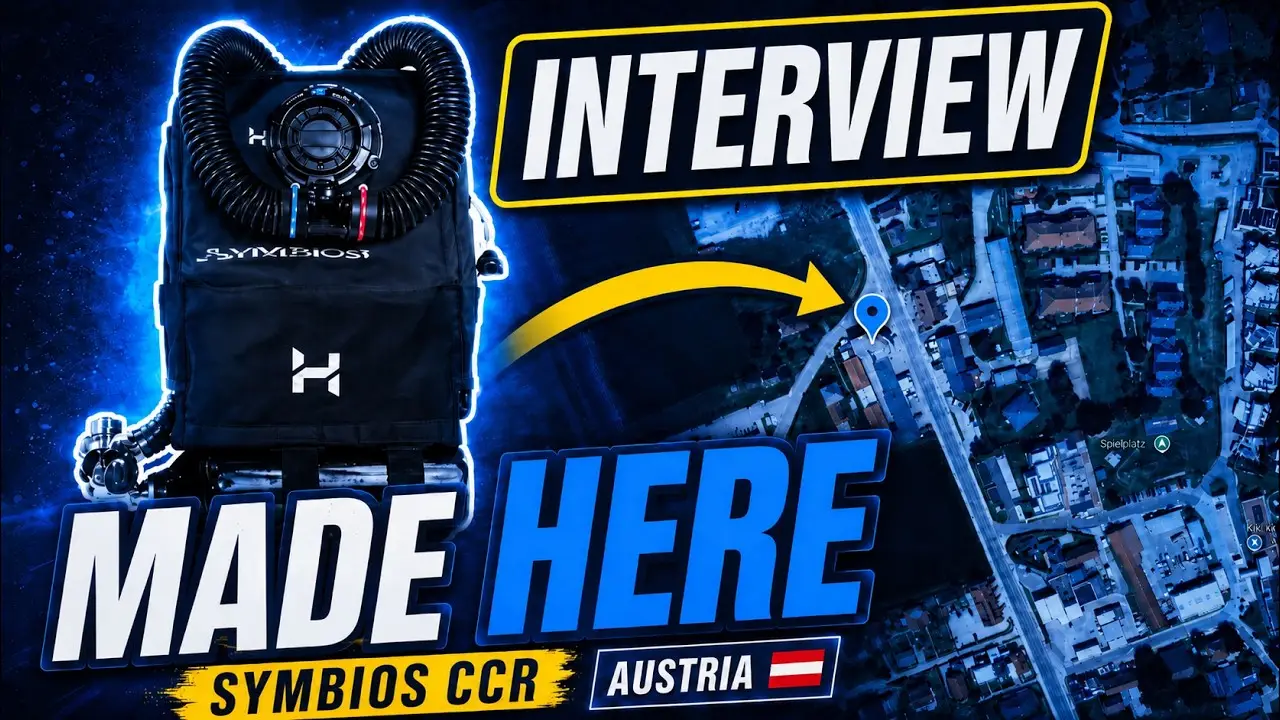
For this video I travelled to Austria, to the place where the Halcyon Symbios was developed and where it is assembled. There I talked to Arne Sieber, the man behind the design. He says straight away that it was a team effort and that it would not have happened without that team. But he is the one who can tell the story, from the first sketch to the CE certification.
How it started: a boat of three and a half metres
Arne has been a diver since childhood, raised by parents who travelled the Mediterranean in a van full of diving gear. He is also an engineer: a professor of biomedical engineering, with years of research in sensor technology. Those two things came together around 2004 and 2005, when he worked on diving physiology in Pisa.
At weekends they went diving at Elba, with their own boat of three and a half metres. Two cylinders fitted on it. So the dives were limited not by depth but by gas. That is where the idea of a rebreather came from: not to go deeper, but to stay longer, with a smaller and lighter system.
From that period also comes the technology for actively validating oxygen sensors, which later went into the Poseidon rebreathers. That company was bought by Johnson Outdoors. In 2021 Arne started on new ideas with a new team, and that became the Symbios.
The wish list
They looked at their own way of diving and asked many people what they wanted. That produced a list Arne calls the Christmas wish list:
- Compact and streamlined, no thicker than twelve centimetres, like an existing small unit people praised, but as a full electronic CCR.
- The safety of a bailout valve, but not the big lump of mouthpiece that usually comes with it.
- Combinable with the open-circuit gear you already have, so the step into rebreather diving becomes smaller. You keep your wing, your inflator, your cylinders, and you add one thing.
- No Christmas tree of cables. Wireless wherever possible.
That last one was not a market wish at the time. People were afraid of it. The team chose it anyway, and now every wish on that list is ticked.
A table full of prototypes
The whole history was on the table. Everything started as a 3D print. The first small white block tested one idea: moving the bailout valve from the mouthpiece to the chest, so the mouthpiece could stay light. First with a lever on top to switch between open and closed circuit; the rotating mechanism came later.
The first versions used parts that already existed, such as the housing of an existing sensor head and connections from BCD parts. They were dived in a lake two minutes from the workshop, eleven metres deep. Many of those prototypes flooded; 3D-printed material is not stable enough. One diver complained that it breathed so hard, and it turned out to be flooded to the top. More than ten versions later came the CNC-machined parts that are in the unit today.
Standard parts are still there, the microcontrollers, the plugs and hoses, the diaphragm of the second stage in the bailout valve. But much was redesigned, because what was for sale did not do exactly what they wanted. The manual injection in the first stage is one example.
The scrubber: the same sorb, a different idea
What surprised me when I moved over from the JJ-CCR: the Symbios scrubber looks smaller, but it takes the same amount of sorb, 2.35 kilos. How?
The design constraint was twelve centimetres of thickness. The first scrubber was axial with a small cross-section and a long bed, in two compartments, like on a rEvo. The final version does the opposite: a large cross-section and a short bed. That is the key to the low work of breathing, because the pressure drop across the scrubber stays small.
The closure was redone several times too. Clamps that leaked because the material flexes, then a bayonet, and now the round port. And because you cannot go to a test institute every week, the team built its own breathing simulator in a pressure vessel. Every version was tested on it.
Five years, and who paid for it
From 2021 to the CE certification with the notified body, in the summer of 2025. Five years with a team, without selling anything. A large part was privately funded, topped up with research funding from the Austrian research promotion agency. “Water and bread for five years,” Arne says. “And sometimes a sausage.”
The certification is for a hundred metres, the depth the European standard addresses. The unit was not designed for 150 metres, and Arne simply says so. For exploration to a hundred or a hundred and twenty metres he thinks it is perfect.
Assembly happens in Austria. The parts come from suppliers all over the world, as local as possible, but also from Asia and the United States.
Who it is for
The Symbios grew out of a recreational problem: too little gas on a small boat. So Arne also sees a place for recreational divers, provided they bring the attention a rebreather demands. Not only to stay longer or go deeper, but for the experience: the silence, the small rig, and fish that come towards you instead of fleeing your bubbles. As a cameraman I know that difference.
His best moment is not one of the prototypes. It is giving a diver who has never dived a rebreather a few minutes of explanation, putting him underwater and seeing that he gets along with it. “Then we have done something right.”
What comes next
- A CO₂ sensor. The slot is already there. Arne expects it in about six months.
- A wireless transmitter for the JJ-CCR. It replaces the HUD on the JJ and lets you use the Halcyon handset and HUD wirelessly. The first units are being tested in the field. Setpoint switching stays on the JJ itself.
- DPV data on the computer. A group of test divers is already using it; so am I, see my video on the SUEX connection.
- The computer as a dashboard. Heating, lights, scooter: every device you carry on one screen.
For anyone wondering whether to buy now or wait: the system was designed as an open system and there is nothing in the pipeline that cannot be updated. Early buyers get a say in where it goes.
The lift question
Finally I asked him: we are in a lift on a tropical island, convince me in one sentence why I need a Symbios. His answer: “I let you dive.” He sees it again and again. People are sceptical, try it, and then put their old unit up for sale.
Everything about the unit itself is on the Symbios page.