Halcyon Symbios CCR
Halcyon Symbios Scrubber Explained: How It Works & How to Fill It
How the Halcyon Symbios scrubber works, why the pack matters, and how to fill it step by step without channelling. Explained by a diver who uses it.
- Brand
- Halcyon
- Product
- Symbios CCR
- Published
- 3 Jul 2026
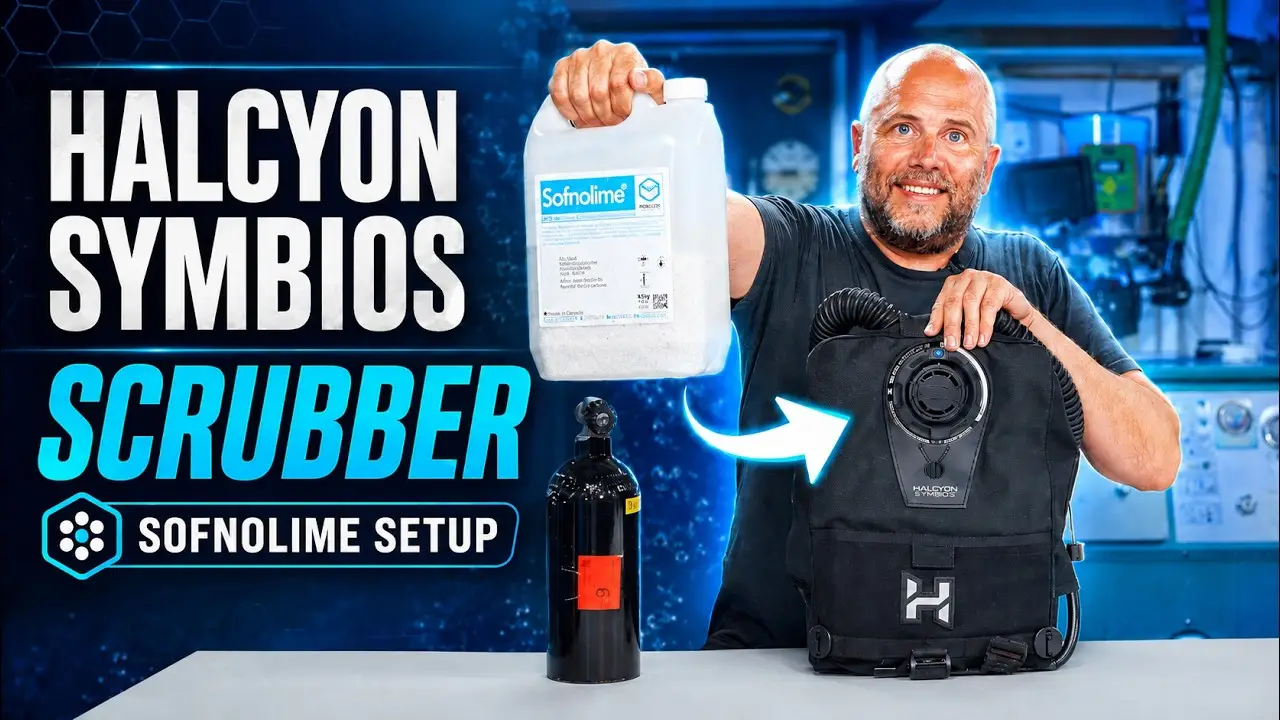
The scrubber is the part of a rebreather that keeps you alive: it takes the carbon dioxide out of the gas you have already breathed so you can breathe it again. On the Halcyon Symbios it also happens to be the part that is nicest to work with. This is how it comes apart, how the gas actually moves through it, and how I pack it.
Where it sits
In normal use the scrubber sits with the lettering facing the body, with the oxygen cylinder below it.
Opening it
Two small levers sit on top. Move them upwards, make sure they are seated at the bottom, and push them outwards. The scrubber pops free — no forcing and no wrestling it out of the housing.
Those same levers then work as a stand, so the unit sits upright on the bench while you fill it. A small thing, but it is the difference between a two-handed job and a three-handed one.
Underneath are two screws. They are captive: they stay attached rather than coming loose in your hand. On a boat that is not a convenience feature — a screw you drop is a screw in the water.
On top of the sorb sits a pad, a sponge-like disc that keeps pressure on the material below so the pack cannot settle and loosen.
How the scrubber actually works
There are two O-rings on the head. Between them there is a hole in the head and a matching hole in the body. That is where oxygen is injected, and from there it joins the exhale side.
So the path runs: exhaled gas plus injected oxygen goes down into the top of the scrubber, passes through the sorb where the carbon dioxide is taken out, comes back up, and leaves again on the inhale side.
Understanding that path is what makes the rest of the maintenance make sense. Gas that finds a way around the sorb instead of through it reaches you with its carbon dioxide still in it.
Filling it
There is a fill line marked inside. The canister looks small the first time you see it, but it takes 2.35 kg of sorb — very nearly the same as the JJ and most other scrubbers on the market.
I use small cans of Sofnolime rather than the large canisters. Where I buy them the price per kilo works out the same, and a small can is far easier to handle over an open scrubber than a heavy one.
The method is the same as any other scrubber:
- Add roughly a third of the sorb.
- Tap the canister so the material settles. I use a rubber mallet rather than my hand — more consistent, and it does not hurt.
- Add the next third and tap again.
- Add the last portion up to the fill line and tap once more.
The tapping is the whole job. A pack with voids in it lets gas channel around the sorb instead of through it, and a channelled scrubber gives far less duration than the fill suggests.
Then the pad goes back on top.
Closing it up
Before the scrubber goes back in, check the O-ring — zie the pressure test. It is greased, which means loose sorb dust sticks to it easily, and sorb on an O-ring is a leak waiting to happen. Wipe it.
The connections are marked red and blue, so there is no guessing which way round it goes. Use the levers again to seat it, push the handles down, and it is closed.
Because the whole thing lifts by the handles, no dirt gets into the hoses while you work.
The source
This describes what I do myself. The Halcyon manual is and remains authoritative.