Halcyon Symbios CCR
Positive & Negative Pressure Test on the Halcyon Symbios CCR
The positive and negative pressure test on the Halcyon Symbios: what each one checks, how to run them, and what to do when one fails.
- Brand
- Halcyon
- Product
- Symbios CCR
- Published
- 16 Jul 2026
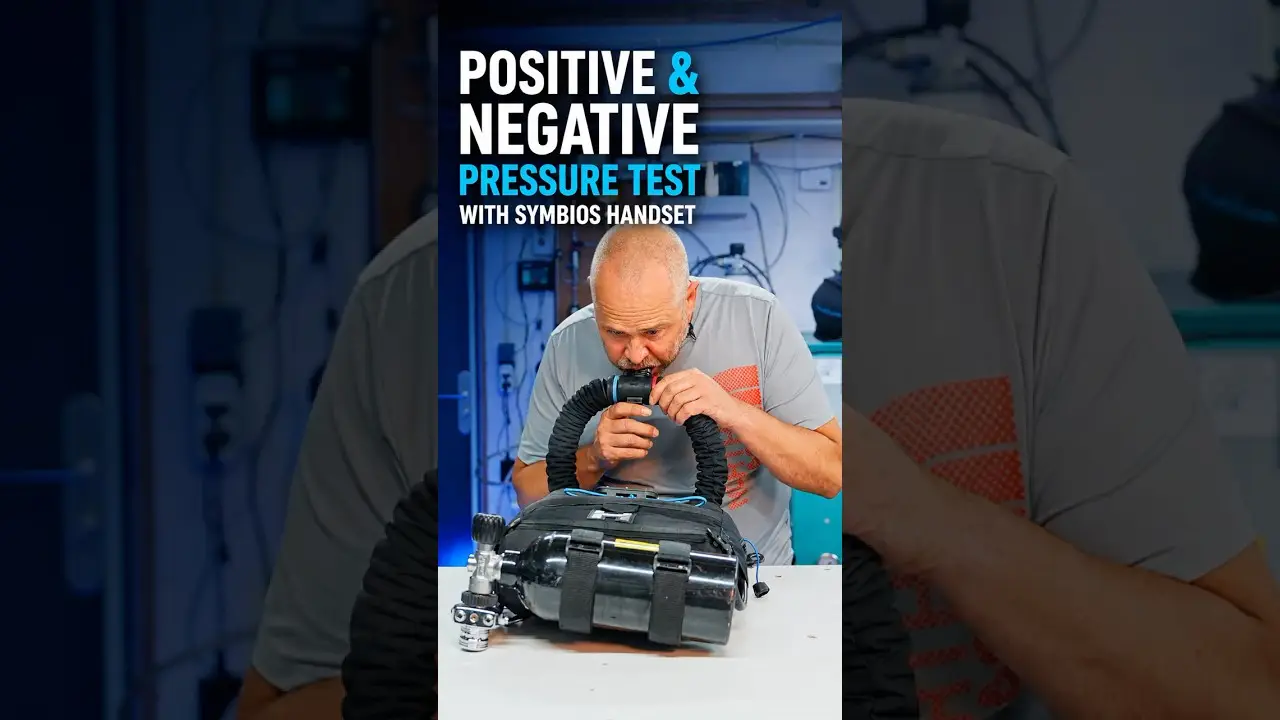
The positive and negative pressure test is the check you run before every dive: it tells you whether the breathing loop is sealed. A leak means losing gas or taking water in, and at depth either one is a problem.
On the Halcyon Symbios the test works together with the handset, and that makes it meaningfully different from most units.
Measuring instead of guessing
On many rebreathers you run this test by feel. You squeeze the counterlung shut, hold it, and try to judge whether anything changed. That is hard: you are comparing a sensation now against a memory from a minute ago, and the margin in which you notice anything is wide.
The Symbios shows the pressure in millibars. No judgement is needed — you read a number, wait, and read the same number again. The value sits in the depth field of the second screen.
Do this first, or your reading means nothing
Calibrate surface pressure at your current location. Skip it and the millibar values can come out wrong while there is nothing at all wrong with the unit.
That happens in particular when you calibrated at a different altitude or location and have not updated surface pressure since. So run a head calibration whenever you change location, and always before the integrity test.
This step is not in my video. It is in the manual, and it decides whether your measurement is worth anything.
The negative test
Set the ADV/BOV to CC+.
Inhale to collapse the counterlungs, close the DSV and hold for three minutes. The counterlungs must stay collapsed.
The positive test
Exhale to inflate the counterlungs, close the DSV and hold for three minutes again. The counterlungs must stay inflated.
The unit starts alarming once the values move outside the normal range — that is expected. A plus sign appears after the millibar value, so you can see you are on the positive side.
In my video I hold for two minutes. The manual specifies three. Follow the manual.
Why both
The two tests find different things. Negative pressure pulls seals inward, positive pressure pushes them out. A leak that closes under one direction can sit open under the other. Run only one and you have half the answer.
And if it fails
Then you do not dive. It is that simple, and the manual says the same: a rebreather that fails its loop integrity tests must not go in the water. Resolve it, replace what is faulty, or have the unit serviced by an authorised technician.
If needed you can remove the outer bag without detaching the loop, so you can go looking for the leak.
The source
This follows the procedure in the Halcyon manual, section 5.9.