Halcyon Symbios CCR
Halcyon Symbios Ecosystem Review: Dive Computer, HUD, Tank Pod & More
A review of the full Halcyon Symbios ecosystem: the dive computer, the HUD, the tank pod, and how those parts actually work together in the water.
- Brand
- Halcyon
- Product
- Symbios CCR
- Published
- 10 Jun 2026
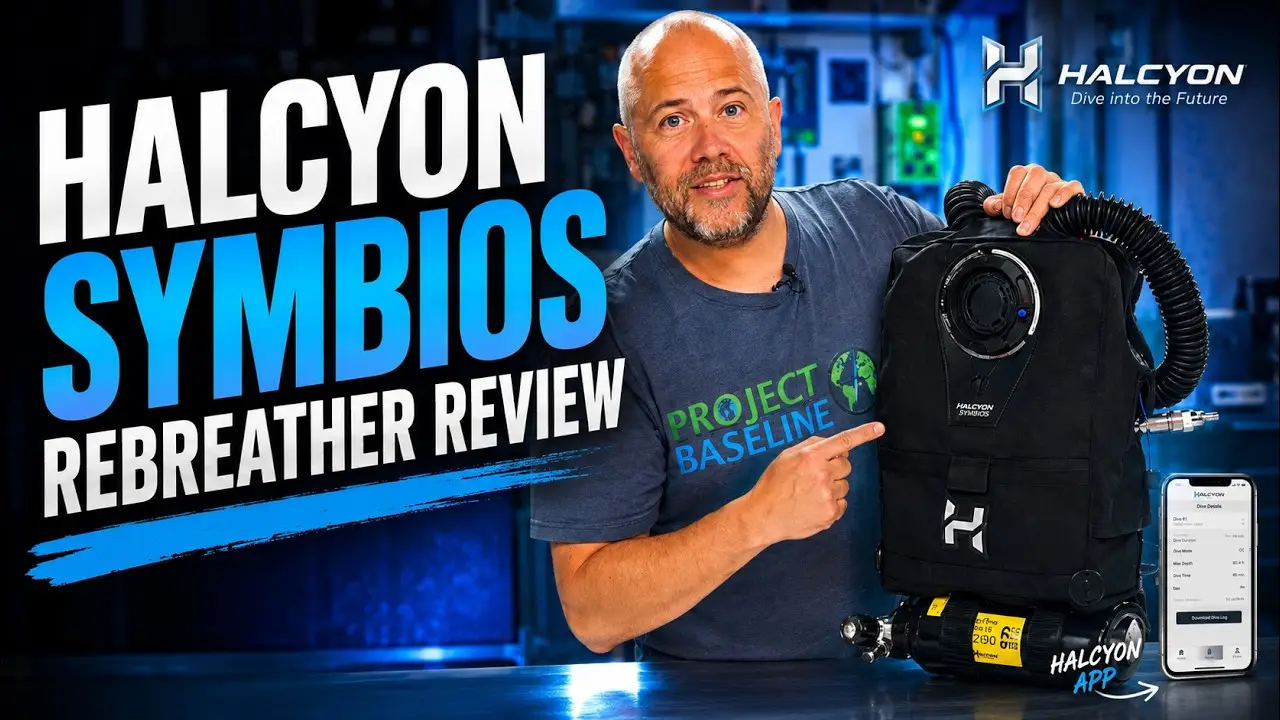
I have been diving this unit for a few weeks now and these are my own findings. This video is not sponsored. Halcyon pays me nothing and I got no t-shirt or sticker.
It started in Austria, where I met Clemens. He talked me through the advantages and the disadvantages, and that opened my eyes: this is more than a biscuit tin you take underwater.
Weight
The first thing that struck me was how light it is. I usually dive a JJ, in standard or Joey config, and that is always far too heavy.
On the scale: 12 kg, including a 1.5 litre aluminium oxygen cylinder that weighs 2.5 kg on its own. Take that off and the unit is under ten kilos.
Submerged it is a different story. With empty lungs and four kilos attached it comes to about 3.6 kg — it is slightly positive. With normally filled lungs you land at around 600 grams.
What that means: empty it is roughly neutral, with gas in it about 2.7 to 3 kilos positive. So you feel a light upward push against your stomach, and that dives well. The oxygen cylinder goes in at 150 bar, so towards the end of the dive it gets slightly more positive still. That bit of lift I find comfortable.
Quick to get on
I have dived it with a single 12, twin 8.5, twin 12 and sidemount. Whatever configuration you have on your back or at your side makes no difference.
There are two rings you mostly use to carry it to the water. Underwater you unclip it, and then it is not in the way when you reach for your drysuit. At first you think that will be a problem; it is not.
There are some further rings I do not use — I honestly do not know what they are for. What I do use: a piece of bungee from your backplate over the loops. That holds the rebreather in place. It started with cookies, but those kept snagging on the line; now they are discs.
The in-system bailout valve
This is one of the strongest points. A bailout valve is a regulator combined with the loop: you switch and you are breathing open circuit, you switch back and you are on the loop.
Usually all of that sits at the mouthpiece. Here it sits inside the unit, which makes the mouthpiece small. On long dives your jaw genuinely notices.
The switch has a definite position. Up is plain open circuit, like a normal regulator. Rotate it and you are on closed circuit.
The good part is that it turns on immediately. It starts vibrating to confirm it is on, even when the unit was completely off, and it sends a signal to the handset and the HUD. So you never switch between open and closed circuit modes on your computer.
There is another button: press and rotate and the work of breathing goes up. Honestly, it breathes so lightly that every dive I made it harder rather than easier.
Breathing, and the mistake I made
It breathes remarkably naturally. You do not have to suck the ADV to get gas — breathing calmly and slowly is enough and it delivers.
On my first dive it still went wrong, and that was me. I was out of trim because I was watching the instructor, and I pushed the unit down because I thought the loop in my mouth needed it. That put the diluent valve below my lungs. The pressure there was higher, so the valve fed gas — and that felt like an overwhelming amount.
Second dive my trim was better and the problem was gone. So make sure your trim is right and do not push the unit down. Keep it slightly up instead, so the ADV sits level with your lungs.
One-handed valve
Rebreather divers: how do you close your valve?
To my mind this is the single biggest convenience here. There are two extra knobs on it, so you open and close with thumb and finger. One-handed.
Why did nobody think of this earlier? You are holding your light, you have kit to carry, your fins — and there you are, struggling. Not anymore.
The link between unit and display
Online I read worrying reports about connections dropping because of heated undersuit batteries. I tried it with my own heating and the connection held.
The problem is also smaller than it looks, because of how it is built: the controller sits inside the unit itself. That is where it happens. The handset and the HUD are displays showing what that controller is doing.
If the connection drops for a few seconds — I saw it two or three times during a one-hour dive — nothing flashes and nothing alarms. Something turns grey instead of white, and a second later it is back. Halcyon are still working on it; for me it is not a big problem.
Handset and HUD
The HUD is surprisingly small and still perfectly readable. I am over fifty and need reading glasses, but I read the HUD without any trouble at all. That says enough.
You set it up from the computer as you are used to: gases, plan, gradient factors. The difference is the app: it remembers your sets. If you have a fixed combination for deeper dives — 100%, 50% and 12/65 as back gas — you build it once in the library and pick it with one click afterwards. No more switching gases on and off. And it syncs between HUD and handset, so you never do it twice.
Switching setpoints
Common question: how do you switch from low to high setpoint? Configuring them runs through the app and the computer.
Not on your computer, but on the unit itself. There is one button, recessed in a hole, with three modes:
- Automatic. It holds the setpoint you configured, but from ten metres and shallower it gives the equivalent of 50%. That stops the unit continuously adding oxygen to hold 1.6; you make that last step manually for your deco.
- Low setpoint.
- High setpoint.
Your computer only confirms what you did — it is a display, not a control panel. Which is welcome, because pressing buttons on the HUD is not the easiest thing underwater.
What I still miss
Buddy mode lets me read my buddy’s values when I hold my arm near my body. Nice, but what I want to know from my buddy is his time to surface or his decompression time. That is the question I still ask by hand signal every dive.
Halcyon, if you are reading: add it.