Documentary
HMS Perseus
Documentary on HMS Perseus, a British submarine lost in 1941 and lying almost intact at fifty-two metres off Kefalonia.
- Location
- Kefalonia, Greece
- Role
- Direction, camera and edit
- Type
- Documentary
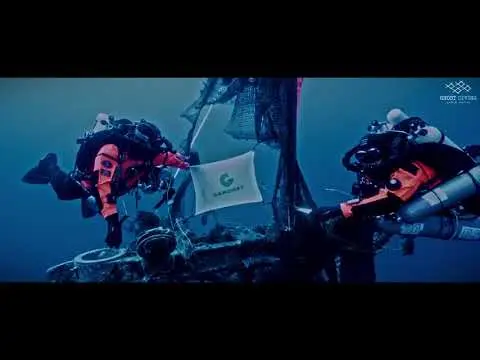
HMS Perseus is a British submarine of the Second World War that struck an Italian mine off Kefalonia on 6 December 1941. She lies almost intact at fifty-two metres.
What makes this wreck remarkable is not only the vessel. It is the escape nobody believed.
The man who got out
Of sixty-one crew, one survived: stoker John Capes. He reached the surface through the escape chamber using a Davis Submerged Escape Apparatus — a forerunner of the rebreather I dive today.
His account was disbelieved for years. Escaping a sunken submarine from fifty-two metres was close to unthinkable in 1941.
Until Greek divers found the wreck in 1997. There they found details only somebody who had been inside could have known.
The diving
The wreck lies about a mile off the south coast of Kefalonia, twenty minutes by boat from Skala or Poros. The dive starts around forty metres and runs to fifty-two on a sand bottom.
Visibility is good — twenty to thirty metres, twenty-five on average. Current is usually limited but can pick up. Because of the depth this is technical diving only.
The conning tower, the deck gun and the torpedo hatches are still standing and clearly visible.
What the filming demanded
Two things made this hard, and they were not the ones you would expect at that depth.
The first is simply the depth: at fifty-two metres you have no time to waste and no room to do anything twice.
The second is colour. Down there almost all the red is gone and what the camera records looks nothing like what the place actually is. Recovering that in the grade was the real work here — more so than the filming.
Direction, camera and edit were all mine.