Article
The five rules of wreck diving
There is no official list of five rules for wreck diving. These are the five cave rules applied to a wreck, with what makes a wreck different from a cave.
- Author
- Rogier Visser
- Certification
- GUE CCR2 · CCR Cave
- Published
- 11 Sept 2026
For caves there is a list of five rules that came out of accident analysis and that every training agency teaches. For wrecks that list does not exist. What does exist: thirty years of literature applying the cave rules to wrecks, and the statement in every serious line protocol that wreck penetration is a dive that requires a line.
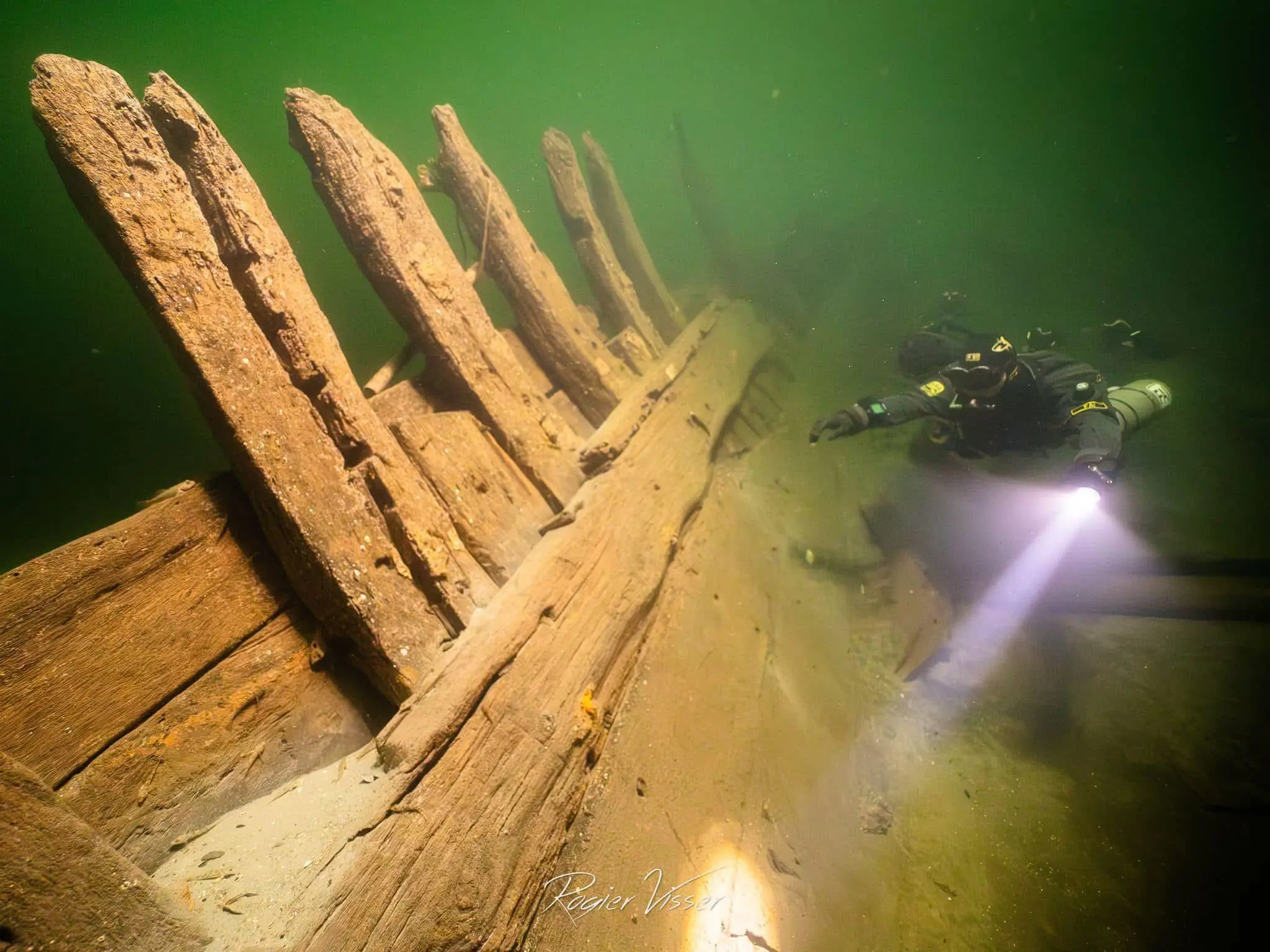
So this article is not an official list. It is the five rules of cave diving, laid rule by rule onto a wreck, with what makes a wreck different. I film and dive wrecks from the Oostvoornse Meer to the North Sea, down to 82 metres on HMS Nottingham. The differences below are not theoretical.
What makes a wreck different from a cave
A cave is old and stable. A wreck is young, and it is collapsing. In a conversation between wreck divers in InDepth earlier this year one of them put it briefly: a cave is static; in wreck diving you have wind, swell, a moving boat, current and decompression in open water. A wreck has sharp edges, tight restrictions, poor visibility, and it is often deep.
And there is a second difference, about divers rather than places. From the same conversation: many wreck divers never develop the same mindset towards the guideline that cave divers do. That is because most wreck diving happens on the outside, or in spaces with several ways in and out. You get used to an overhead you can always get out of somewhere. Until you are in a space where you cannot.
The numbers are old but not refuted. A 1991 analysis from the University of Rhode Island found that 73 per cent of accidents involving wreck penetration were due to the lack of a continuous guideline. Of the deaths outside the wreck, 42 per cent were out-of-gas emergencies. That is cave rules two and three, in a different environment.
Rule 1: training, and which training
The remark in Blueprint for Survival 2.0 from 1995 still holds: extensive wreck experience does not qualify you for cave diving, and vice versa. But in this year’s conversation one of the wreck divers says something I agree with: one of the most valuable things to look for when building a wreck-penetration team is a background in cave diving.
The reason is not that cave divers are better wreck divers. It is that cave training forces you to make line, gas, light and team a reflex, in an environment that allows no exception. Whoever brings that to a wreck has only the wreck-specific things left to learn: reading an unstable structure, the behaviour of rust and silt, and diving with decompression in open water above a wreck in current.
Rule 2: a line, even when there are several exits
In a cave there is often a permanent line already. In a wreck almost never. The first explorers of a wreck lay their own line, and on a wreck that is you, on nearly every dive.
The protocol is the same as in a cave: primary tie-off outside the wreck, with direct access to open water. Secondary tie-off just inside. And the assumption when laying it is the same: you must be able to follow this line in zero visibility while sharing gas. On a wreck that means something extra: no line over a sharp edge, because steel cuts line, and no line through an opening that can fall shut.
The argument you often hear here is that a line is unnecessary because there are several exits. Two accidents from the early nineties say enough. On the Andrea Doria a diver drowned after getting separated from the mainline during a penetration. On U-869 in 1992 father and son Rouse died after the son was trapped by falling debris. An exit that was there when you went in need not be there when you come back.
Rule 3: gas, plus the deco above it
The rule of thirds applies in every overhead, and Blueprint for Survival 2.0 says it without detour: always dive your bottom gas in an overhead using at least the rule of thirds. But the same piece also names the big difference from a cave: in a cave you can stage gas along the route, on a wreck at sea usually not reliably. You carry what you need.
And something is added that a cave does not have: the decompression above the wreck, in open water, in current, with a boat you have to find. That gas comes on top of your thirds and on top of your minimum gas. The definition of minimum gas still stands, enough to reach the surface from the farthest point while sharing gas, but the farthest point of a wreck dive is not at the exit of the wreck. It is at the end of the deco.
On a rebreather the bailout rule from the cave applies in full: always enough to get out and up from the farthest point. In the InDepth conversation one of the wreck divers says that divers systematically underestimate how much bailout gas is truly required if the rebreather fails. At 82 metres I work that out before I step onto the boat, not on the way down.
Rule 4: depth, and therefore gas
Caves in Europe often lie within thirty metres. Wrecks do not. The North Sea wrecks worth diving lie between thirty and fifty metres, and the finest deeper. That does not make the depth rule stricter on wrecks, but it does make it apply more often.
The reading of this rule is the same as for caves: the problem is not depth but air at depth. An equivalent narcotic depth of no more than thirty metres and an oxygen partial pressure of no more than 1.4 bar, and so helium in the gas as soon as you go below that. On a wreck at forty metres, in North Sea visibility, in current, air narcosis is exactly what you cannot use when a door slams shut. The standard gases are made for this: 21/35 to 45 metres, 18/45 below that, and on the rebreather the same gas as diluent. On HMS Nottingham, at 82 metres, I dived 12/65 as diluent.
Rule 5: light, and what the silt does
Three lights, as in a cave. But visibility in a wreck disappears in a different way. In a cave you stir silt up from the floor, and you see it coming. In a wreck it also comes from above: rust and sediment lying on every plate and pipe that is loosened by your exhaled bubbles or by the pressure from your fins, and then comes down like rain. Your visibility does not go because of what you are doing, but because of what you did a minute ago.
That is why the light rule on a wreck is above all a visibility rule. You assume you will have to exit in zero visibility, even if you saw ten metres on the way in. What that means is in rule two: the line is already there before the visibility goes.
What is added: the team
Above the five rules stands the team, and on wrecks that matters even more if anything. In the InDepth conversation one participant says: you need a backup brain, and that backup brain is the team. In a collapsing wreck at fifty metres, with an hour of deco above you, the team is also the only one who sees that you have missed something.
The rest is exactly what applies to caves too: a certification is a licence to learn, a gas beyond its range is a mistake, and the equipment has to be right. Whoever has that in order has enough with the five rules. Whoever does not will not manage with ten.
Filming wrecks is the largest part of my work. If you want to see the sites where I practise: the wrecks of the Oostvoornse Meer are on this site with depth charts.
Sources
What this article rests on: training standards, accident analyses and the original literature.
- GUE: Introduction to Guideline Procedures, part 2 (names wreck penetration explicitly)gue.com
- Menduno & Deans: Blueprint for Survival 2.0 (1995), InDepthindepthmag.com
- The Wrecks Are Not Going Anywhere, InDepth The Talks, 2026indepthmag.com
- An Analysis of Cave Diving Accidents (from GUE's Deep Into Cave Diving), InDepth 2025indepthmag.com
- Michael Menduno: Early Technical Diving Deaths, InDepthindepthmag.com
- Rich Walker: Standard Gases, InDepth 2021indepthmag.com
- GUE Standards: CCR Cave (v10.2), the bailout rulegue.com