Article
The five rules of cave diving
Training, guideline, gas, depth, light. Where the five rules of cave diving come from, what accident analysis says and how to apply them.
- Author
- Rogier Visser
- Certification
- GUE CCR2 · CCR Cave
- Published
- 11 Sept 2026
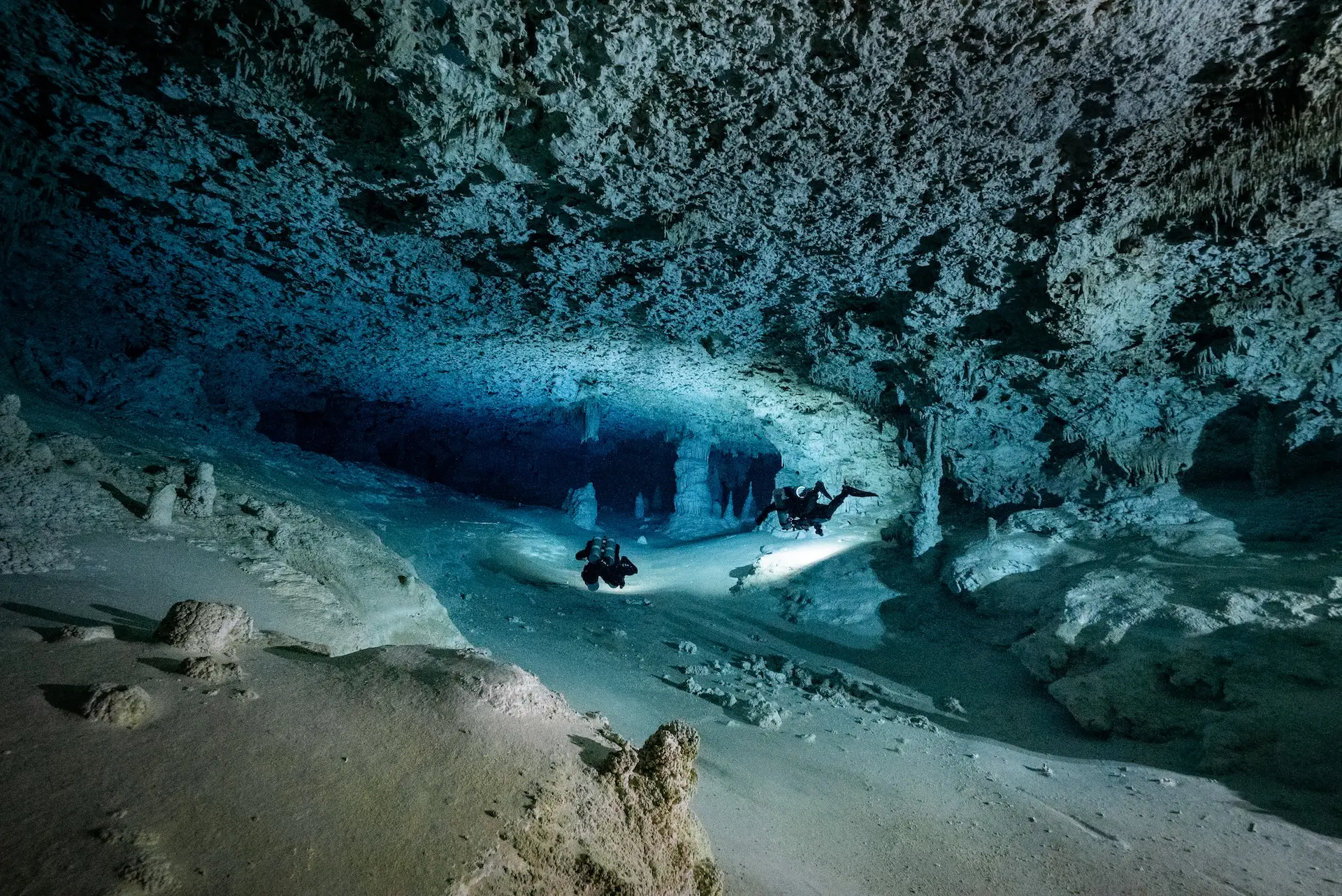
Every cave diver knows them, and almost every fatal cave accident can be traced to breaking at least one of them. Training, guideline, gas, depth, light. Five rules, in that order. They were not thought up at a desk. They were derived from the dead.
I dive caves and flooded mines on a rebreather. This is how I learned the five rules, where they come from, and where modern technical training applies them more strictly or differently than the original list.
Where the rules come from
In 1979 Sheck Exley published Basic Cave Diving: A Blueprint for Survival. Not a textbook but an accident analysis: chapter by chapter he describes an accident and what it teaches. Exley saw that the dead fell into three groups. No continuous guideline to open water. Not two thirds of the gas kept for the way out. Too deep.
In 1984 two more were added, because the analysis kept showing them as contributing causes: lack of cave training and insufficient light. That is the list every agency teaches today, usually in this order: training, guideline, gas, depth, light.
The numbers behind it are not old. A DAN study of thirty years of American cave fatalities, from 1985 to 2015, counted 161 deaths. Of those, 87 had no cave training, more than half. The most common cause of death was drowning after running out of gas, usually after getting lost in stirred-up silt. Over those thirty years the number of deaths per year fell from eight to fewer than three. The rules work.
Rule 1: training
The first rule is first for a reason. A diver without cave training does not know the other four, or knows them only as text. Training is where the rules go from knowledge to reflex.
Good cave training is built in steps, and every step has hard limits. The first level comes only after a technical foundation and a solid number of dives outside training, and then limits you to thirty metres, without jumps or traverses between lines, with a gas plan more conservative than the classic rule of thirds. The second level follows after dozens of dives at the first, and that is where jumps, stages and longer penetrations come in. Cave diving on a rebreather sits on top of that again, with one rule that sums it all up: you always carry enough bailout gas to exit the cave from the farthest point.
What every serious agency adds to the first rule is the caveat that a card is not proof of skill. A certification is a licence to learn. An accident inside the limits of your card but outside your own comfort is still an accident.
Rule 2: a continuous guideline to open water
In a cave, visibility is not a given. One fin kick in the silt and you cannot see your own hand. The line is then the only thing that brings you out, which is why it has to run without a break from where you are to open water.
The line protocol starts outside the cave. The primary tie-off gets two wraps around an object with direct access to open water. The secondary tie-off follows as soon as you are under the overhead. When laying line you assume the worst case: you must be able to follow that line in zero visibility while sharing gas with your buddy. So no line through cracks a hand cannot pass, and no line pulled tight over an edge where it can be cut.
On the permanent lines deeper in the system it comes down to marking. Each diver places their own marker at every jump: a cookie as a non-directional marker, an arrow where direction matters. They have one purpose: that on the way back, at every junction, you know without thinking which way leads out.
And one rule that holds for the whole line: the team on its way out has right of way. Always.
Rule 3: gas
The classic rule is the rule of thirds. One third for the way in, one third for the way out, one third in reserve. The first team member to reach their third turns the whole team.
Technical diving has added a second concept that the rule of thirds does not cover: minimum gas. That is the amount of gas you need to reach the surface from the deepest or farthest point while sharing gas with a diver who has none. That quantity sits apart from your thirds. It is the floor you never go below.
The third part is the choice of gas itself. Instead of calculating a different mix for every dive, many teams work with a fixed series of standard gases: 32 per cent nitrox, then trimix 30/30, 21/35, 18/45, 15/55. They are chosen so that the oxygen partial pressure stays around 1.2 to 1.3 bar during the working part of the dive and the equivalent narcotic depth never exceeds thirty metres. The advantage is more than convenience: when everyone in the team dives the same gas, gas sharing is arithmetically trivial and the wrong cylinder on the wrong regulator is no longer a fatal mistake.
On a rebreather the arithmetic changes, not the principle. Diluent is a standard gas. Bailout is the open-circuit planning of old, in the place where you need it most: at the farthest point, with a unit that has given up.
Rule 4: depth
Exley named depth as the third cause, and in the statistics for trained cave divers it actually comes first. The sharper reading, found in every modern accident analysis: depth itself is not the problem, diving air at depth is. Almost all deep cave accidents are air accidents. There are remarkably few with sensible helium mixes.
So the line is drawn not at a depth but at two numbers that depend on the gas: an equivalent narcotic depth of no more than thirty metres and an oxygen partial pressure of no more than 1.4 bar. At around thirty-six metres air narcosis starts to become very persuasive, and the only reliable solution is never to exceed thirty metres of narcotic depth. Helium is not a luxury, it is how you keep rule four.
Cave courses themselves generally stop at thirty metres. Not because caves end there, but because the skills you learn above it have to be in place first.
Rule 5: light
The rule says: at least three lights. One primary, two backups. In a good configuration they are fixed: the primary with a rechargeable battery and a Goodman handle, the two backups on alkaline batteries, not rechargeable, with a twist switch, stowed on the chest D-rings. Alkaline because a backup light hangs unused for months and then has to work.
Light is more than seeing. It is communication. A light moving steadily forward says without words that the diver behind it is fine. A light that stops or suddenly sweeps says the opposite. That is passive communication, and it is the reason you do not have to keep looking back in a team.
If the primary light fails, the position in the team is fixed: in the middle with three divers, in front with two. And a diver who has followed the other four rules gets out even after a total loss of light. The line is there, the gas is there. You go slowly.
What comes with the five
The five rules are a minimum, and the accident analysis itself says so. Left alone, the list creates the illusion of well-defined risk. At least three more things belong with it: your personal level of comfort, gases dived beyond their range, and improper or insufficient equipment.
And above all of that stands the team. The buddy system of recreational diving was already rejected in 1995 as not reliable enough for technical diving. What replaces it is a team of divers who can each manage alone, and precisely for that reason can do more together. A rule of thumb I use myself: train so that you can give a quarter of your attention to monitoring the situation and keep three quarters for what you came to do. When the five rules are a reflex, that quarter is enough.
The rules on a rebreather
One last thing, because I dive a rebreather myself. Exley’s analysis comes from a time without rebreathers and without scooters. A rebreather diver therefore needs a solid set of open-circuit skills plus enough gas to survive the unit giving up.
The five rules do not change because of that. The gas rule becomes a bailout rule, and the training rule gets stricter. The line, the depth and the light stay exactly what they were.
If you want to see the rules in practice: on DiveJunk I show how I build, test and maintain my own unit. And if you want to learn them on the Halcyon Symbios, you can take a course with me.
Sources
What this article rests on: training standards, accident analyses and the original literature.
- An Analysis of Cave Diving Accidents (from GUE's Deep Into Cave Diving), InDepth 2025indepthmag.com
- GUE Standards: Cave 1 (v10.2)gue.com
- GUE Standards: Cave 2 (v10.2)gue.com
- GUE Standards: CCR Cave (v10.2)gue.com
- GUE: Introduction to Guideline Procedures, part 2gue.com
- GUE: The Essentials of Cave Navigation (Quest, 2005)gue.com
- GUE Procedural Changes, August 2005 (minimum gas, cookies, light failure)gue.com
- Rich Walker: Standard Gases, InDepth 2021indepthmag.com
- Jarrod Jablonski: Team Diving, InDepth 2026indepthmag.com
- Guy Shockey: Situational Awareness and Decision Making in Diving, InDepthindepthmag.com
- Menduno & Deans: Blueprint for Survival 2.0 (1995), InDepthindepthmag.com
- Potts, Buzzacott & Denoble: Thirty years of American cave diving fatalities (2016)pubmed.ncbi.nlm.nih.gov
- NSS-CDS: Basic Cave Diving, A Blueprint for Survival (Sheck Exley, 1979)nsscds.org